Music: Interview with San Fermin

Updated: Aug 10, 2025

Inside the American indie rock collective, led by Brooklyn-based composer and songwriter Ellis Ludwig-Leone.
By: Anna Vartsaba
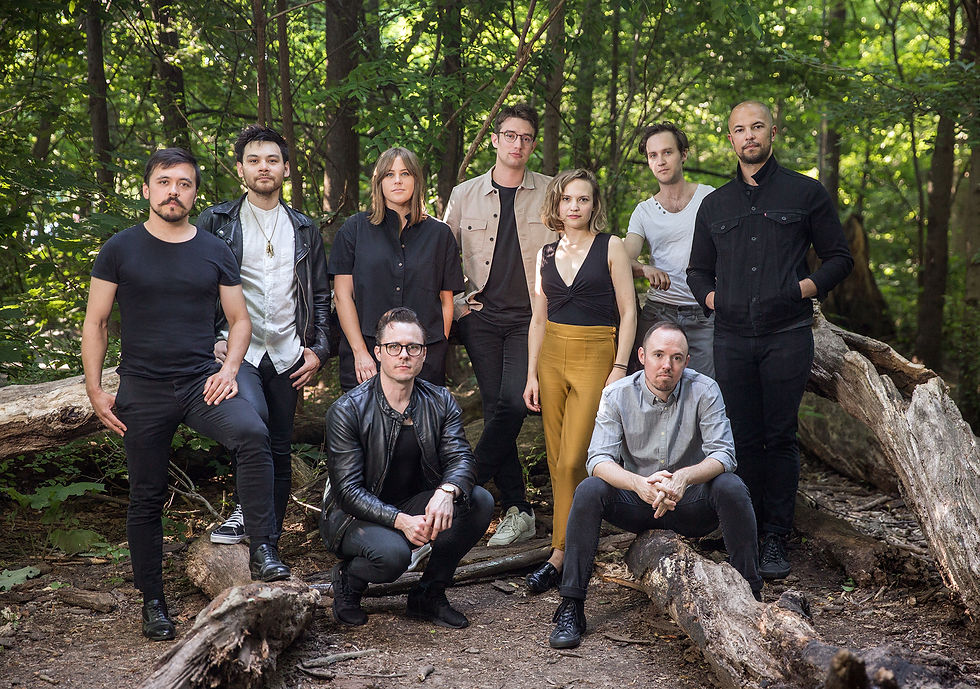
A composer, lyricist, and performer - Ellis Ludwig-Leone is the brilliant visionary of the New York-based band “San Fermin.” The unique origins of the collective began with a one time project guided by Ellis featuring 22 collaborators that later decreased to its touring size of 8. With the single being a success, the project became a band with now 4 successful albums and multiple singles. While leading “San Fermin”, Ellis also finds time to compose for other organizations and musicians and has written five ballets for Troy Schumacher’s ballet company, various orchestras, ensembles, and more.
This interview and the photographs were completed in April. Even though I could not have possibly covered the extent of Ellis’ career and work, some of his most notable projects and processes are included. As Ellis Ludwig-Leone continues to create and take the indie rock world by storm, it's my pleasure to present my most burning questions about what was, what is, and what will be.
Was it a conscious decision to pursue a music career or was it something you just loved, and fell into?
“Every member of my immediate family, and some of my extended family, are visual artists. I used to love drawing and painting as well, but as soon as I discovered the piano I knew music was my path forward. I like the social aspect of it: the fact that concerts bring lots of people together to have a communal experience. It’s also a fairly egalitarian medium, in that basically anyone can access and enjoy it, which I like...I knew I wanted to be a musician, but I wasn’t sure which part of the music world I would fit into. I still don’t. But I’ve just tried to work with interesting people, not be an asshole, and hope that one thing leads to another.”
Why did you decide to structure the band in this way?
“We just fell into it. The first record I wrote for 22 musicians. I never thought we would have to tour it. But then our record label told me we had to take it on the road, so I arranged it for 8 musicians. It just stuck.”
What is your music writing process like?
“It depends from project to project, but the one constant is that I always sketch out the structure of the whole thing first, and try to keep an eye towards serving that structure as I go. Even albums for the band, I start with a unifying concept and a list of songs I want to write before I actually start. I don’t do well at piecing something together… I need the architecture.” For “the Cormorant”, “I wrote the lyrics first, which is the first time I’ve done it that way. Once I had the lyrics for a song, I would demo the music in Logic. I always write for all the instruments at once, rather than just doing it on a piano or guitar. That way the arrangement gets wound into the storytelling in a way that feels essential.”
What made the experience writing “the Cormorant” different from the rest?
“I went to this tiny town called Ísafjörður, way up in the northwest part of Iceland, where I have some friends. A lot of my music deals with natural themes— animals, mountains, swamps— they all tend to end up in my lyrics, and the landscape in the Westfjörds is just amazing. So every morning I would go for a walk through the fjords and then come back feeling energized to write. There were sea birds everywhere, which is where the title of the album came from.”
How has composing for all of these various orchestras and ensembles affected the music written for the band?
“It’s actually allowed me to get out of my own way a bit. For a while I was like, “every song has to have everything in it!” But now it’s like, maybe that musical idea is better suited for a string quartet or an orchestra or a ballet or whatever. In the last few months I’ve been trying to write songs with more empty space, to give room for the lyrics to tell the story. That freedom comes from the fact that I know I can write for all those instruments somewhere else.”
What was a favorite collaboration? Why?
“I’m working on a show with Troy and Karen Russell called The Night Falls, which is an evening-length theater/dance piece. Working with Karen is great because she has this magnetic energy and her writing is so good; she has this constant stream of ideas that are deeply imaginative, disarmingly honest and darkly funny at the same time. We had an immediate connection and I hope we will keep working together for a long time.” As for when composing for Schumacher’s ballet company, “Troy is fun to work with in that he’s fiercely loyal to the concept of collaboration. Like, if we’re doing a piece with a poet, or a painter, or an architect, he’s committed to having multiple conversations with those artists to allow them to impact the process. We’re working on a piece right now with an amazing poet named Carey McHugh, and when we were planning the piece, the three of us had multiple meetings, went to a museum, and even had a long conversation with a brain specialist about how memory works, before anybody wrote a word or a note. Being given that kind of time to let a project gestate before starting is unusual. And in the end, the music that comes out is much different than anything I would have written on my own.”
What is “American Music” and what kind of approach are you taking towards this specific project?
“It’s a full-length musical commissioned by American Repertory Theatre, with a book by Jane Mendelsohn and directed by Diane Paulus. It’s a traditional musical in the sense that it’s got two acts, a script, and a bunch of songs, but the team is unique in that neither Jane or I come from a musical theater background. I think we were both interested in seeing how we could tell a story that honors the form without falling into some of the traditional tropes of musical theater. It’s an interesting challenge musically because each song has to bring the drama and tell a story without going totally over the top. I’ve had to rely on a pretty wide skill set— some songs are like festival bangers that I might write for San Fermin, while others are subtler and quieter, and then the underscore lives in a more classical music-type world. It’s a fun challenge, as a composer, to do all those things in one piece, and it's exciting.”
How has the variety in your work benefitted your career?
“It keeps me questioning my approach by coming into contact with other artists who have different approaches. I think if I was just, say, hanging with a bunch of songwriters, I might get stuck a bit in one line of thinking. But working on projects with choreographers, novelists, poets, playwrights, etc. puts me in a position where I can watch those artists work, and keeps me reconsidering how I can incorporate those ideas into my music.” All of the projects are “just different angles of the same sculpture I guess? Like, when it comes down to it, the same basic principles are at play whether it’s a song or a musical or a harp concerto. Which are: does it feel honest, and is it going about achieving its goal in a way that is smart, attractive, and generous? That applies just as much to lyric writing as it does to, say, the harmonic development of an instrumental piece. At its core, it’s all just about communicating clearly (or unclearly, if that’s the intention!).”
What artists are you a fan of/inspired by?
“So many! But I just wrote a thing for Under the Radar about how much I love Kate Bush, so let’s go with that. Outside of music, I really admire writers… I feel like that medium is the most unforgiving in certain ways, because there’s no barrier to entry, so your thoughts have to be really special to convince people to care about them.” There’s also New York which is “a city that keeps you in constant contact with other creators. So there’s always a concert or a play to see, which inevitably informs your work.”
One of your favorite performances? Favorite song to perform?
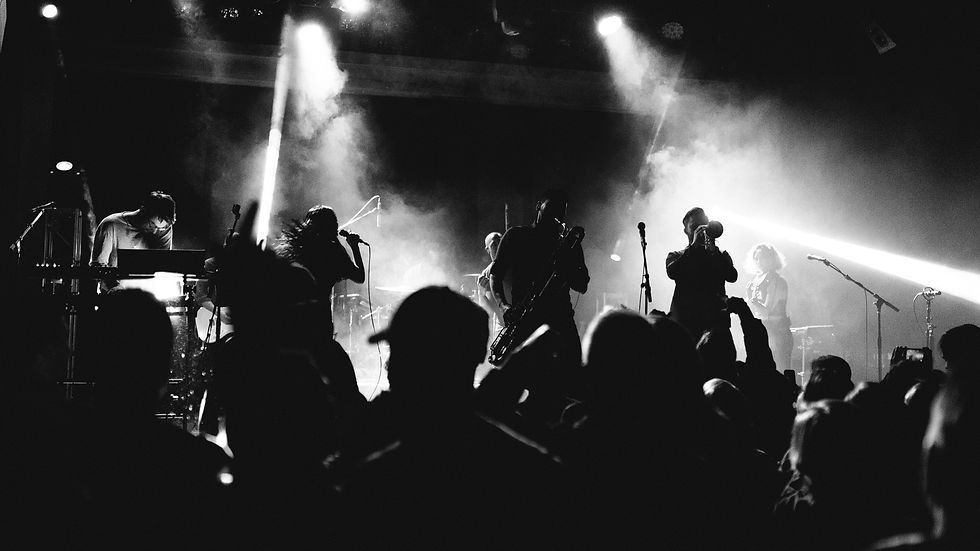
“Probably my favorite show ever was opening for alt-J at Austin Music Hall in 2015, right before that venue closed. We had been on a super long tour with alt-j, and had played ACL that afternoon after an all-night drive, and everyone was exhausted, but exhilarated. We had the audience in our hands in a way that was really special. My favorite venue is probably Brooklyn Steel, which we’ve been lucky enough to headline twice. It’s a beautiful new room and each time it reminds me why hometown shows are so special.” Right now, my favorite song to perform is”... “Belong,” from our third record, which has been a real grower for me. I like the lyrics for that one, which, usually I can’t stand my lyrics after I put a song out, but for some reason that one has a good mixture of light and dark that feels right.”
What are the next steps for you?
“I’m working on a ballet that (hopefully) should premiere in the fall. A choral piece, a harp piece, some work on the musical. I’m also working on a record of my classical, non-band music, which has been exciting and a bit scary.” As for aspiring musicians, “involve yourself with people whose work you admire. Make yourself useful to them and use the opportunity to learn as much as possible.”
—
Anna Vartsaba is a creative based out of Brooklyn, NY. As a writer, singer, and designer, she can be followed in her artistic endeavors on Instagram @anna.vartsaba


Comments